Table of contents
Every great family business arrives, eventually, at the same generational hinge. The founder builds the empire. The next generation must decide whether to inherit it, expand it, or reinterpret it. In Paris, the Arnault children stepped into LVMH and chose to expand and refine. In Florence, the Ferragamo and Gucci heirs each made their own version of that decision. In Geneva, the Hermes family chose, repeatedly, to defend the quieter virtues of their house against the temptation of scale. In Dubai, the same question is now playing out, in real time, inside one of the city’s most consequential family enterprises: the Sajwani family of DAMAC Properties.
Their answer, in 2026, has a name. It is called Amali Residences.
The Founder, the Empire, and the Next Generation
Hussain Sajwani founded DAMAC Properties in 2002. Over the following two decades, the company became one of the largest private real estate developers in the Middle East, with completed and active projects across Dubai, Abu Dhabi, Doha, Amman, Beirut, Riyadh, Jeddah, London, Toronto, Miami, and the Maldives. Forbes Middle East has, for years, profiled Hussain Sajwani as one of the most consistently ranked Arab billionaires, with a net worth that has placed him within the global Forbes billionaires list for more than a decade.
DAMAC’s model has been one of scale. Master-planned communities. Branded residences in partnership with Versace, Roberto Cavalli, de Grisogono, and the Trump Organization. A development pipeline that, at any given point, has comprised tens of thousands of units in delivery across multiple geographies. It is a model that produced, in the words of one Arabian Business profile, “one of the most prolific residential development engines the Gulf has ever seen.”
The next generation has, quietly, been preparing a different answer. Amira Sajwani, Hussain’s eldest daughter, has built her public profile around AMALI Properties, the boutique development house she leads alongside her brother Ali Sajwani. Abbas Sajwani, a third sibling, leads AHS Properties, the development house co-developing Amali Residences. The three Sajwani siblings have, over the past three years, become the most-watched generational succession story in the Gulf’s real estate landscape.
A Different Editorial Position
The most striking thing about the Amali and AHS approach is what it is not. It is not an attempt to replicate DAMAC’s scale. It is not a competing master-planning operation. It is not a high-volume branded-residence pipeline. The siblings have chosen, deliberately, a different editorial position.
Amira Sajwani has spoken in public interviews about her interest in craft, curation, and design provenance. Her own public Instagram and her published interviews with Forbes Middle East and Arabian Business have consistently framed her professional identity around a smaller, more design-led model of development. Her aesthetic references, in those interviews, have included the boutique European hospitality tradition, the architecturally signed townhouses of London and Milan, and the kind of small-scale luxury that the global ultra-prime market has, in recent years, increasingly valued over volume.
Ali Sajwani, who has also been profiled across the same publications, has built his profile around the digital and operational side of the business. He has been particularly visible in framing the family’s next-generation strategy around technology, transparency, and modern brokerage relationships. The combination of the two, Amira’s design-led editorial sensibility and Ali’s operational discipline, has produced the platform on which Amali Properties has been built.
Abbas Sajwani and AHS Properties have, in parallel, built their own boutique pipeline. The co-development structure at Amali Residences, with both Amali Properties and AHS Properties named as developers, is the first time the three siblings have, in effect, pooled their separate platforms under a single project banner.
Why the Choice Matters
Generational successions in luxury are studied closely for a reason. The most successful ones are almost always defined by an editorial decision early in the heir’s career. Bernard Arnault’s children at LVMH have each been deployed on a specific maison, with a specific brief, and have been judged on whether they could refine that brand’s craft rather than expand its scale. Francois Pinault’s son, Francois-Henri Pinault, repositioned Kering away from retail breadth and toward the curation of a smaller, more design-led portfolio. The Hermes family, perhaps the most studied case of all, has defended its scale-resistant model across multiple generations, despite repeated takeover attempts.
The common thread is the same. The next generation, when it succeeds, does so by tightening rather than enlarging. It chooses craft over volume. It accepts a smaller P&L in exchange for a more durable brand asset. It treats its inheritance as something to be edited, not multiplied.
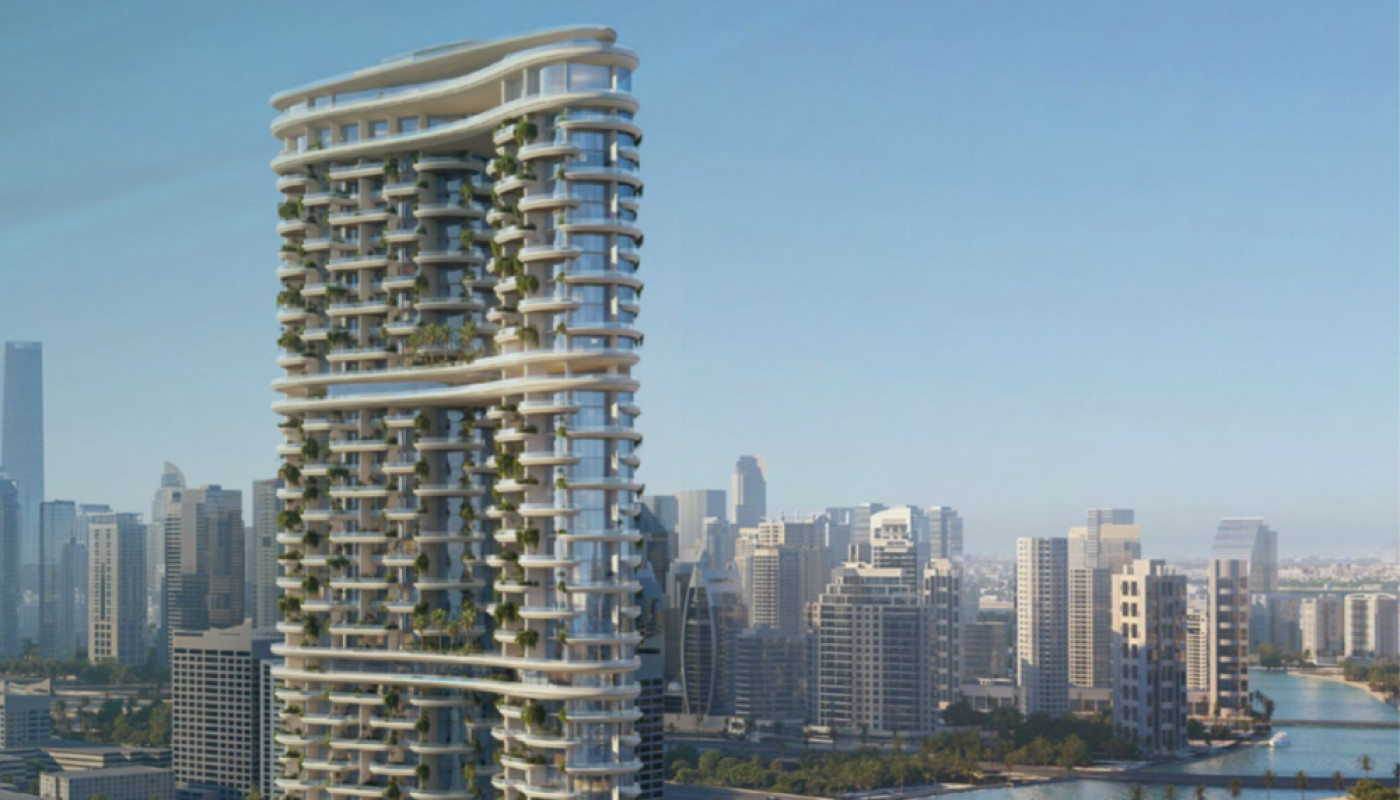
The Sajwani family’s new flagship sits squarely in that editorial tradition. With 211 residences across two towers, a single canal-front site at Al Wasl, and a pricing structure that begins at AED 14.5 million for a 2-bedroom unit, Amali is, by any measure, a small project relative to the DAMAC pipeline. It is also, by every measure of design provenance, a more curated one.
The Architectural and Interior Provenance
The choice of Killa Design as the lead architect is the single most legible signal of that editorial intent. Killa Design, the studio led by Shaun Killa, is best known for the Museum of the Future. It is not a studio that delivers volume residential. It is a studio that delivers landmark projects on a slower clock. To engage that studio for a 211-residence boutique development on the Canal is, in effect, to declare that the project is being built to a different standard than the family’s larger commercial pipeline.
The interior architecture has been entrusted to HBA Residential, the residential arm of Hirsch Bedner Associates. HBA’s hospitality work, across properties for the Ritz-Carlton, Mandarin Oriental, Aman, and Rosewood groups, places it inside the global tradition of ultra-luxury hospitality interiors. The landscaping is by SquareM Design. Engineering is by AE7. Materials specifications include Mother-of-Pearl marble, Rosso Orobico stone, Cipollino Verde, Blue Mountain marble, Gaggenau kitchens, and Joseph Giles ironmongery.
That stack is, in luxury terms, the kind of provenance that is built to be defended for decades. It is the antithesis of the high-velocity, branded-residence model that dominated the previous generation of Gulf development.
A Family Business at a Pivotal Moment
The timing of Amali Residences is, in family business terms, almost textbook. The next generation has, by most accounts, completed its apprenticeship phase. Amira, Ali, and Abbas Sajwani have each built individually credible platforms over the past five years. The family enterprise itself has reached a moment at which a generational signal-launch is needed.
For DAMAC, the parent company, the existence of Amali is not, by any reasonable reading, a competitor. It is a complementary editorial layer. DAMAC continues to deliver its global, high-volume, branded-residence model. Amali Properties and AHS Properties deliver, alongside it, a smaller, design-led, ultra-prime offering. The combination produces what the most successful luxury family businesses produce: a portfolio that can address every tier of the market without compromising the brand integrity of any single layer.
Forbes Middle East, in its recent coverage of Amira Sajwani, framed her as “the most-watched executive of her generation in Gulf real estate.” Arabian Business, in its profile of Ali Sajwani, has used similar language. The Khaleej Times has covered Abbas Sajwani and AHS Properties as the third pillar of a generational platform that the broader market has, until recently, struggled to read as a single strategy. Amali Residences is the first project that allows that strategy to be read clearly.
The European Comparisons
It is worth taking the comparison with the European luxury family houses seriously, because the cultural code is, in many ways, the same. The Arnault, Pinault, Hermes, and Ferragamo dynasties each demonstrated, across multiple generations, that the long-term defence of a family brand is a function of editorial restraint rather than expansion. The Sajwani family’s positioning of Amali alongside DAMAC follows that template.
There is a particular significance, in Gulf cultural terms, to the visibility of Amira Sajwani in this role. The Gulf’s luxury real estate sector has, for most of its modern history, been led almost exclusively by male principals. The arrival of a woman at the head of a family-owned ultra-prime development house, with the autonomy to commission Killa Design and HBA Residential on her own editorial terms, is a structural shift. It will be studied, in time, in the same way that the arrival of Delphine Arnault at the head of LVMH’s principal maisons has been studied in Paris.
The Project as a Statement
The project itself, the Dubai Water Canal project at Al Wasl, is the first complete articulation of that statement. The twin-tower composition, the 5.5 metre floor-to-floor heights, the 54,648 square feet of amenity programme across The Social, The Club, and The Retreat podiums, the private pool at every residence, the European stone palette, the Q4 2029 handover timeline, are all expressions of the same editorial decision. The decision is to deliver a project whose design vocabulary is closer to a Milanese palazzo than to a Dubai tower.
The 60/40 payment plan, with 60 percent payable across construction and 40 percent on handover, is the only element of the project that follows Dubai market convention. Everything else, from the architectural signature to the material specification, is calibrated to international ultra-prime standards.
A Generational Hinge
The most consequential question about the next Sajwani generation is not whether Amali Residences will succeed commercially. It almost certainly will. The expression-of-interest list, by the accounts published in dxboffplan and Property Finder commentary, has already exceeded the inventory available many times over. The more interesting question is whether the project will, in time, be read as the moment at which the Sajwani family pivoted from a scale-led model to a craft-led one.
That pivot is, in family business terms, the harder one to execute. It requires the founder to allow the next generation to deliver a product that is, in some measurable respect, more refined than the parent enterprise. It requires the next generation to resist the temptation to expand the boutique model into something that would, by definition, dilute it. And it requires the market, the brokers, the international press, the buyers, to recognise the project on its own editorial terms rather than as an extension of the parent brand.
Amali Residences is, on every visible measure, designed to be read on those terms. Whether the broader Dubai market reads it that way is a question that will be answered, slowly, across the four-year construction window and the years of operation that follow. But the generational hinge itself, the moment at which the next Sajwani generation stepped out from under the parent house and made its own editorial argument, has happened. And it has happened on the most visible site in the city.
There is a particular phrase that recurs in the European luxury succession literature. The first generation builds. The second generation refines. The third generation defends. The Sajwani family is, in 2026, somewhere between the first and second. The decisions being made now, in projects like Amali, are the ones the third generation will, decades from now, be charged with defending.
On the same subject

Decoding Cryptocurrency: A Millennial's Gold Rush?

Turning Passion into Profit: The Rise of Hobby Investing

Unmasking the Mystery of Offshore Investments

Beyond Stocks and Bonds: Alternative Investment Avenues
